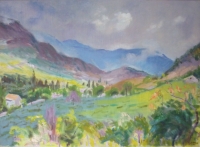
P194 Harry Maas girls in a meadow
Beautiful colorful oil painting by painter Harry Maas from Eindhoven known for his, sometimes mischievous nude, paintings with a predilection for feminine beauty.
The painter Harry Maas (1906-1982) or in full Harry Frans Hubert Maas received drawing lessons as a boy and joins various art circles at a later age. One of them is the Eindhovensche Schetsclub where nude models are drawn, among other things. Harry Maas's works can be seen regularly at exhibitions and exhibitions of the associations, as well as at national exhibitions. Since the 1950s, Harry Maas has exhibited little, he sells his paintings through various art dealers.' Harry Maas' work includes various portraits, nudes, cityscapes and some landscapes.
In 1940 he became a member of the Bredasche Kunstkring with other Eindhoven residents, with which circle he also exhibited several times. He is represented with work at the national exhibitions Onze kunst van heden (Amsterdam 1939) and Kunst in Vrijheid (Amsterdam 1945). After the Second World War, he participated as a member of Kunstkring De Kempen in the visual art exhibitions and the last of the Eindhoven Sketch Club near Pijnenborg in 1949. After that he is not exhibiting, because he would have no work in stock. He sells a lot through the art stores Roelofs in Amsterdam and Beckers in Eindhoven. A more obvious reason is that other views in the art present themselves and reviews resound more criticism of his work, whereby the fact that he lost one eye in the bombing on December 6, 1942 may have influenced his artistic achievements. After his father's death, Harry moved from Akkerstraat 23 to Ooistraat 25 and around 1970 he moved into a house at Kleine Berg 79.
Although the Sketch Club officially died in 1969, he continues to draw model weekly with a group of friends, Kees Houtman, Jan Louwers, Karel Vermeeren and Sjef van der Voort. In 1974 he married the younger, naive painter Netty (Antoinette Cecilia Catharina) Michels (1919-1995) in Nijmegen, who had been coming to him for years and helping him. On June 4, 1982, Harry Maas dies in Eindhoven and is buried at the Catharinakerkhof. In the 1930s, Harry Maas became famous as a draftsman and as a painter of portraits and figures. In addition, he makes linocuts and starts etching. His preferred model – and great love – is Jeanne (Adriana Maria) van den Bogaard (1913-2003). The love is not mutual but they always remain friends with each other as well as with her twin sister Mary (Maria Adriana) van den Bogaard. During the war period, Harry has brushed many still lifes. Around 1950, many cityscapes and landscapes were created as a result of trips to England and Paris. His passion for locomotives and steam trams has a permanent place in his oeuvre, with or not upholstered with fashionably dressed, graceful (school) girls. The feminine – half-dressed or spicy – naked runs like a common thread through his work and the countless, elaborate nudes in oil, watercolor, black or red chalk and the quick quarter sketches of girls posing for him have given Harry Maas his reputation. Yet this type of erotic work has somewhat distracted attention from his real artistry and qualities (source: Museum Kempenland).
Harrie Maas has had a passion for drawing and painting from an early age. In Roermond he gets his first lessons with M.G. Hölscher and in Nijmegen at Anton Kloosterhuis. After the family moved to Eindhoven in July 1931, he developed himself further and joined the art brothers at the Eindhoven Sketch Club. He has been the driving force of this club for decades. After 1950, he hardly exhibited anymore. He has since built up a circle of admirers and his work finds its way to buyers through fixed art dealers. In 1974, he married Netty Michels in Nijmegen, who had success with her narrative cloths in a naive painting style. In the 1930s, Harry Maas became famous as a draftsman and painter of portraits and figures. Around the war period he has brushed many (flower) still lifes. Around 1950, many cityscapes and landscapes were created as a result of trips to England and France. His passion for trains is given a permanent place in his oeuvre, where he often falls back on nostalgic images and for the upholstery as well as in his cityscapes chooses fashionable, graceful girls. The feminine clean half-dressed or spicy naked runs like a red thread through his work and the countless, elaborate or sketchy nudes of girls posing for him have given him great fame.
Literature: Harry Maas "Painter of city life and feminine beauty" Peter Thoben, Pieter Scheen.
Site by Artimin