Abrahaham Brueghel (1631-1690) and Nicola Vaccaro (1640-1709)

Ships from The Netherlands


Premier Seller
Description

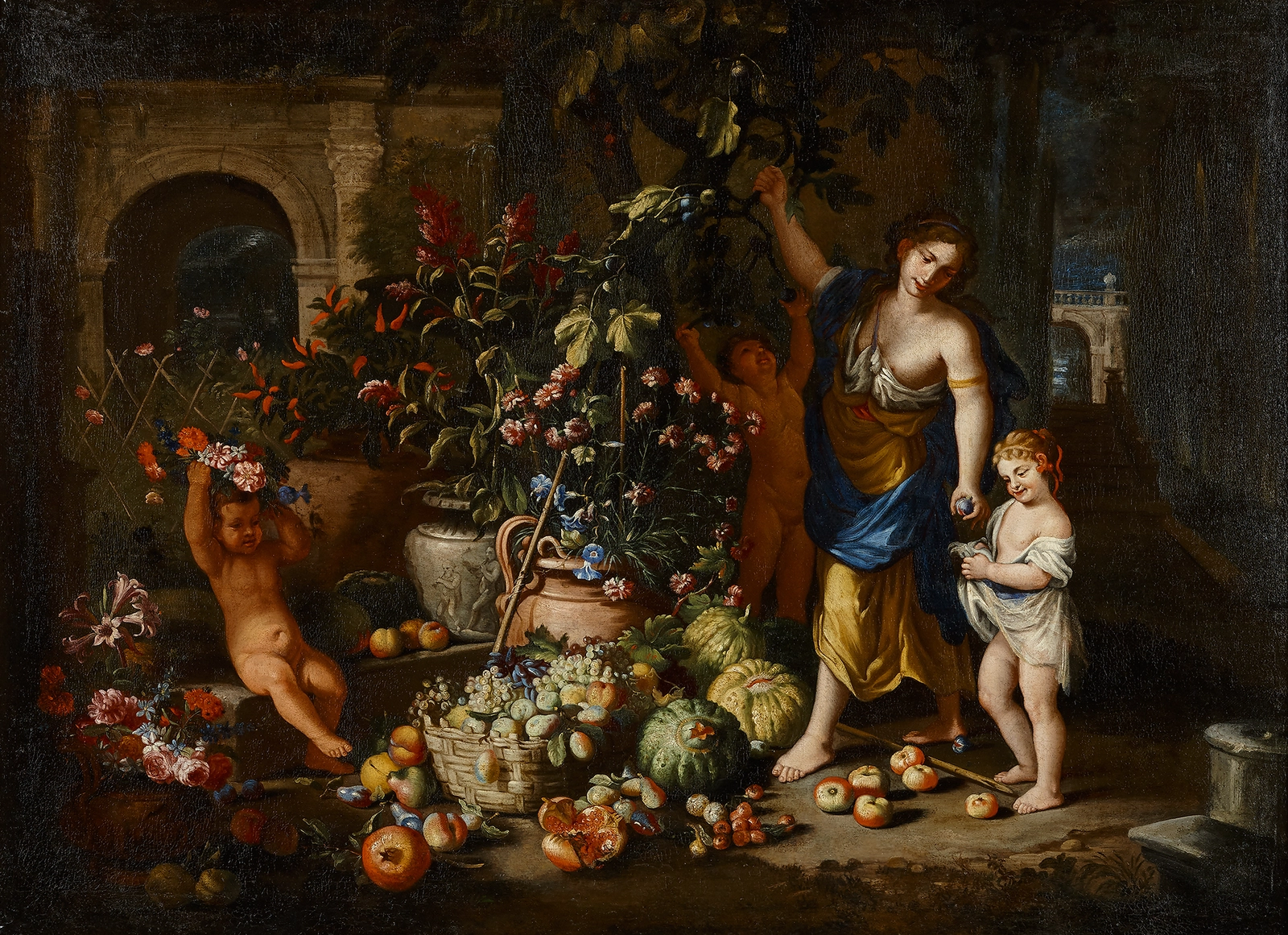
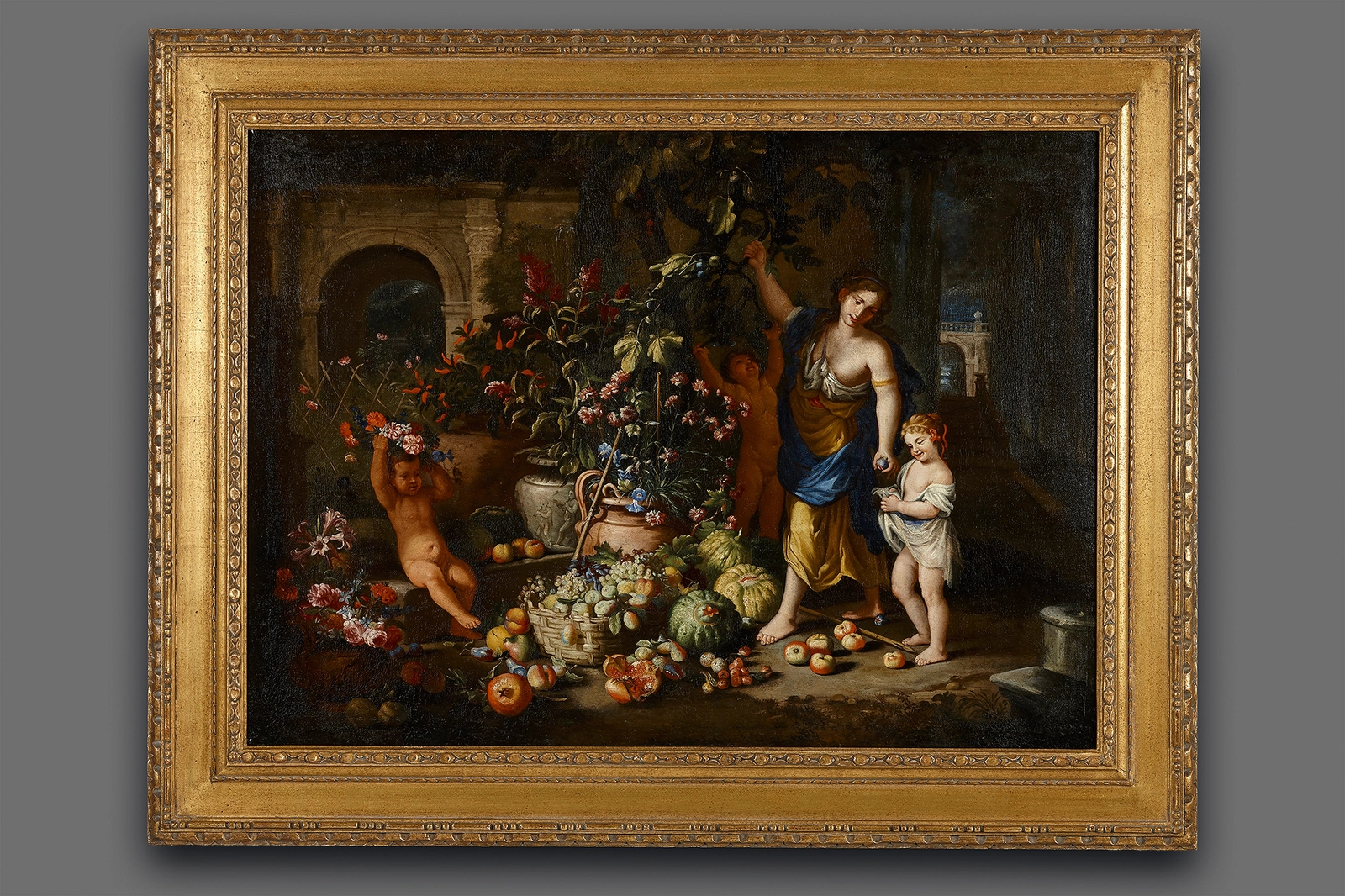
In a lush Arcadian garden full of blooming flowers and freshly picked fruit, a young woman picks figs in the company of a young girl and two boys.

Everything depicted in the scene depicts and symbolizes fertility, clearly the main subject of the painting. The many ‘sub-themes’ that can be discerned in the painting must have made the work the perfect piece for conversation during the 17th century. In the visual arts, the motif of picking fruit was often used to represent the summer month of August. And, for artists this was an effective way to show off their talent in the rendering of abundances of harvested fruit in baskets and all sorts of blooming flowers. Finally, there is also an erotic connotation in the depiction of picking fruit, which must have immediately been obvious to a 17th-century beholder.

This Italian painting was created in collaboration between the two painters Abraham Brueghel and Nicola Vaccaro. This working method was not unusual in the 17th century. Antwerp-born Abraham Brueghel, a descendant of the famous Brueghels, collaborated very often with other artists, as did his ancestor Jan Brueghel.

Abraham Brueghel was the son of Jan Brueghel the Younger. He is also known as "Rhyngraef" and "Neapolitan". He was a renowned still painter of  fruit and flowers but also made landscapes. At a young age, Brueghel left his native Antwerp for Italy where, in 1649, he was commissioned to work for the Sicilian prince and art collector Antonio Ruffo. After 1660, he moved to Rome and in 1671 he permanently settled in Naples. It was here that he worked together with various artists, especially figurative painters, who added staffage to his still lifes. This painting, for which he collaborated with Nicola Vaccaro, was a success, as another signed version by both artists is kept in a private collection.

The Neapolitan Nicola Vaccaro was an artist and theatre director who, as a painter, depicted various  subjects on canvas. He worked together with numerous painters, such as Aniello Ascione and Andrea Belvedere, for whom he integrated staffage into still lifes and landscapes. This particular work is an excellent example of the collaboration of Vaccaro and Abraham Brueghel and their skills. It was painted sometime between 1680 and 1690.

Literature:
Abraham Cottino, Abraham Brueghel 1631-1697; un maestro della natura morta Fra Anversa, Roma e Napoli, Bologna, 2022, p. 176

Origin and period
Collection Paul Giersberg, Wesel Auction Math. lempertsche Kunstversteigerung, april 16th, 1907 Private collection
Name
Abrahaham Brueghel (1631-1690) and Nicola Vaccaro (1640-1709)
Categories
Fine Art Paintings
Periods
17th Century ca. 1690 Antique
Materials
oil on canvas
Styles
Renaissance
Measurements
Height: 74 cm, Width: 101 cm
Reference
KOLA100457
Premier Seller
Artlistings seller since 2015

Ask the seller

More from this seller

You may also like

    A ivory travel cutlery

    A ivory travel cutlery

    Peter van Boucle (1600-1673)

    Peter van Boucle (1600-1673)

    Sebastiaan Vrancx (1573-1647)

    Sebastiaan Vrancx (1573-1647)

    Jean Grandjean (1752-1781)

    Jean Grandjean (1752-1781)

    Jacob Toorenvliet

    Jacob Toorenvliet

    Jacob Toorenvliet

    Stll life with flowers and fruit

    Stll life with flowers and fruit

    Set of eight gouache drawings

    Set of eight gouache drawings

    Farmers couple

    Farmers couple

    Quirijn van Tiel