Dani Pascariu
a year ago
Great store, good prices (Netherlands)
Expedition depuis Pays-Bas
Prix sur demande Prix sur demande Prix sur demande Prix sur demande Prix sur demande Prix sur demande Prix sur demande Prix sur demande Prix sur demande

Contacter le vendeur
Kollenburg Antiquairs BV
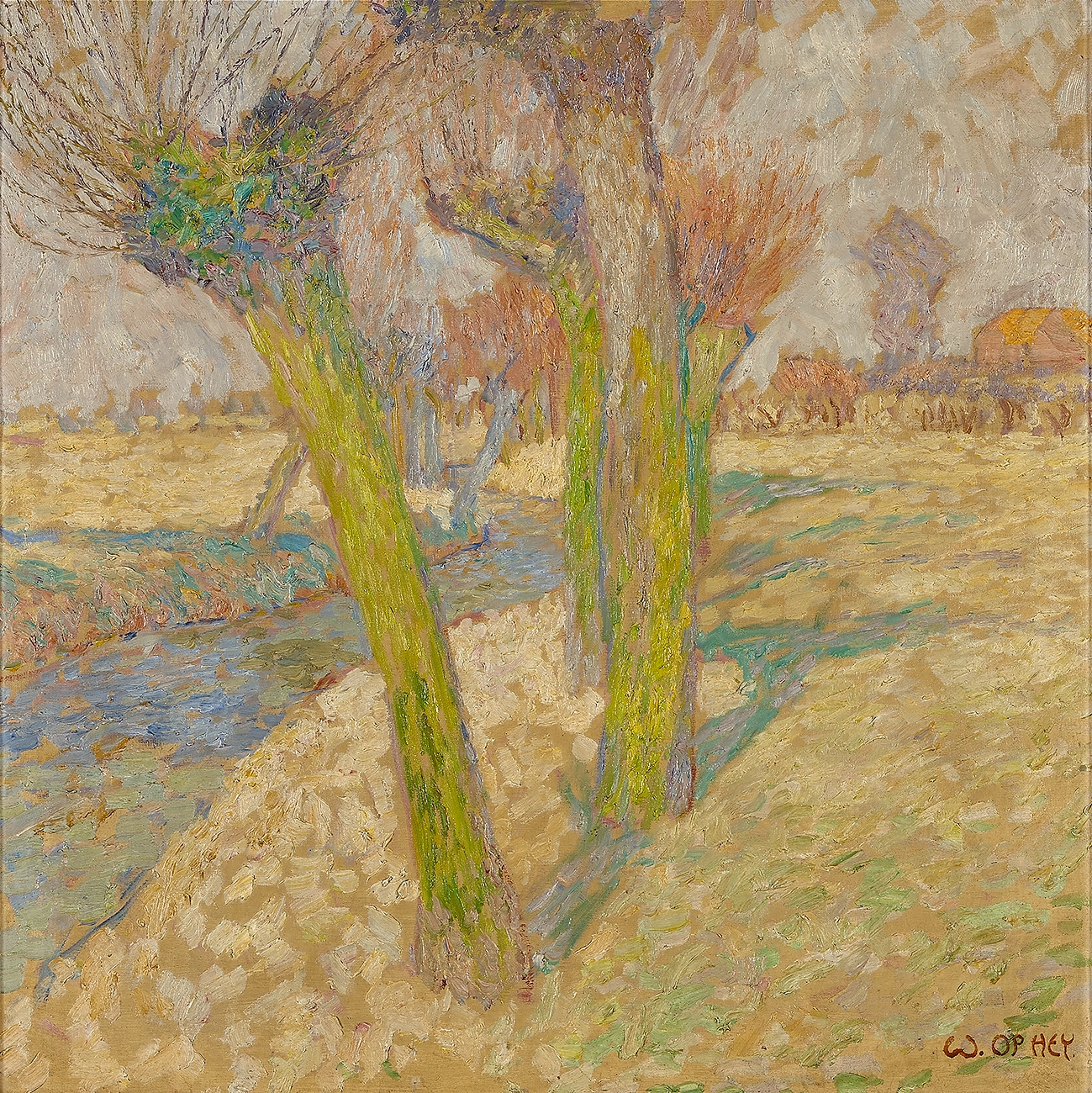
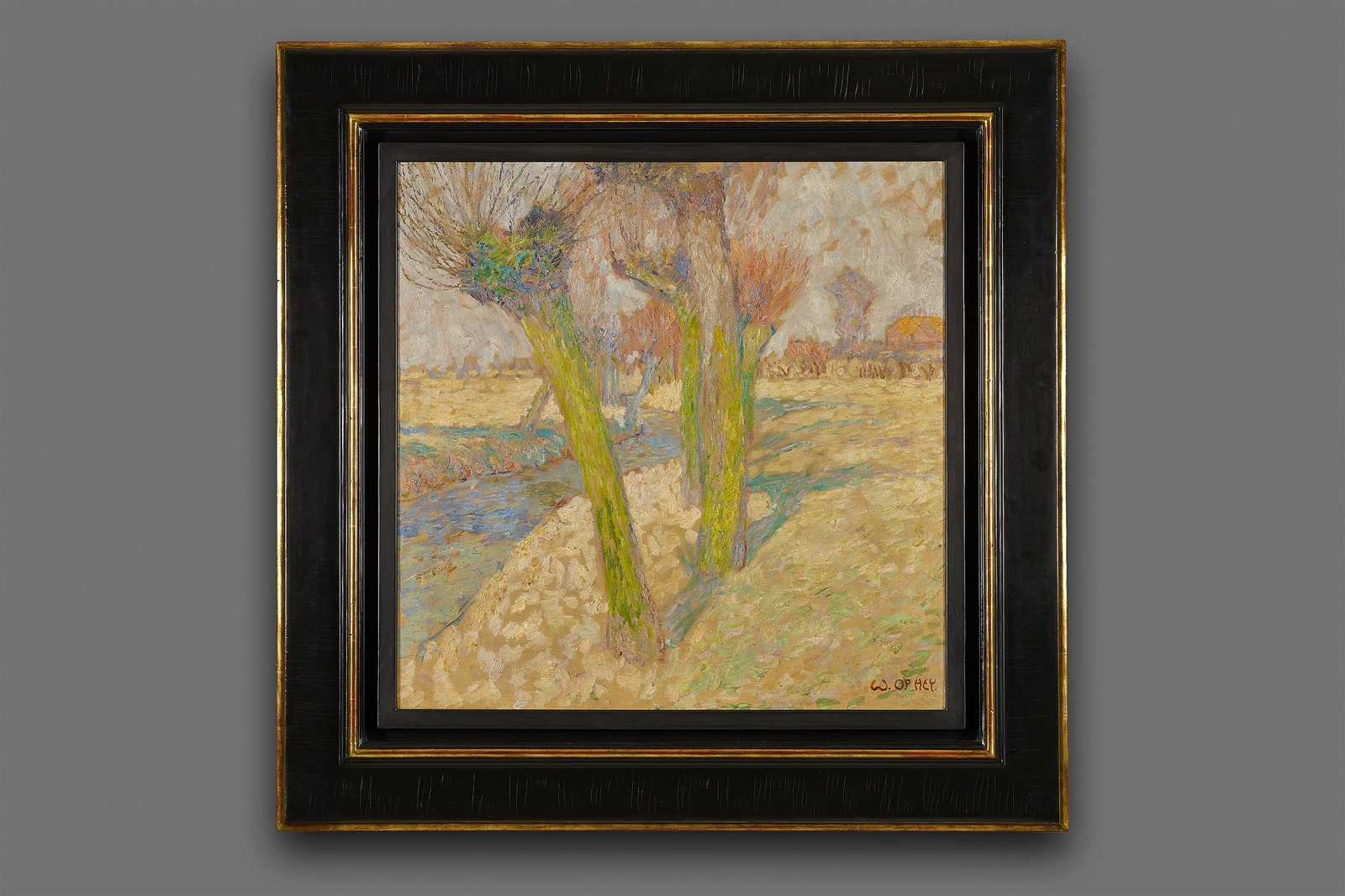
This large, sun-drenched scene shows a landscape with pollard willows along a river and a farm in the distance. The work was painted in a smooth, impressionist style, using a light palette. The main feature of this painting is the scintillating sunlight, which reflects onto the willows and casts shadows on the ground, giving the whole a sunny and lively feel.
The Rhineland artist Walter Ophey (1882 -1930) began his studies at the Düsseldorf academy of art at the age of 18. Alongside Agust Macke and Heinrich Nauen, he grew to become one of the most prominent representatives of Expressionism in the Rhineland.
Sonderbund
Together with the painters Julius Bretz, Max Clarenbach, August Deusser and Wilhelm, Ophey founded the art society Sonderbund Westdeutscher Kunstfreunde und Künstler, more commonly known by the shortened form “Sonderbund”, in 1909. Sonderbund’s fourth International Exhibition, which opened in Cologne in May 1912, is seen as the most important presentation of European modernist works before World War I. The exhibition included not just works by the collective itself, but also pieces by Van Gogh, Cézanne, Gauguin, Picasso, Bonnard and Paul Signac.
In 1910 Ophey travelled to Italy, then to Paris in the following year, where he resided close to the famous artists’ café Le Dôme on Boulevard Montparnasse, and met many artists. The city made such an impression on him that he developed a new perspective on the development of the art scene in the German cities. He came to see everything that Düsseldorf had to offer as outmoded; compared to Paris, even Berlin lost its glamour. This idea – that Germany’s art and art world, however lively, were lagging behind Paris and its Modernism – was partially responsible for changes among the artists’ societies of Düsseldorf, where Ophey co-founded the collective Das Junge Rheinland in 1919.
Walter Ophey liked to base his work directly on reality, and travelled extensively with his sketchbook. Although he stands as one of the great names of German Expressionism, he developed a completely unique style with a picturesque, romantic quality. Even in his most expressionist period, the colours he used had a certain gentleness about them; his palette is always recognisable and very distinctive.
Entartete Kunst
The Nazis viewed Ophey’s expressionist works as degenerate, and in 1937 a significant number of them were confiscated from public collections during the Entartete Kunst campaign, a term used to describe art that did not meet the requirements of the Nazi regime. This primarily concerned contemporary modern art – abstract and expressionist art, for example. One of the driving forces behind the famous 1937 exhibition that bore this title was Wolfgang Willrich, who – with the approval of the Nazi authorities – was chiefly responsible for the removal of some 16,000 “degenerate” paintings from German public collections. Most of these were 20th-century expressionist works.
Of these approximately 16,000 works, 650 were sent on tour to serve as special examples of Entartete Kunst. The paintings and statues were grouped closely together, noting the purchase price of each piece, the museum that had purchased it, and the year of purchase. The exhibition space was also adorned with racist slogans. The intention was to provoke feelings of aversion among the public in response to the artworks and the large sums that had been paid for them. The traveling exhibition first opened in Munich on 19 July 1937, and was hosted in eleven other German and Austrian cities over the next four years. It was the largest and best-attended traveling exhibition of its day, drawing approximately three million visitors.
Littérature:
Stefan Kraus, Walter Ophey 1882-1930; Leben und Werk mit einem Werkverzeichnis der Gemälde und Drukgraphik, 1993, G209