Dani Pascariu
a year ago
Great store, good prices (Netherlands)
Ships from The Netherlands
Price on request Price on request Price on request Price on request Price on request Price on request Price on request Price on request Price on request

Message the seller
Kollenburg Antiquairs BV
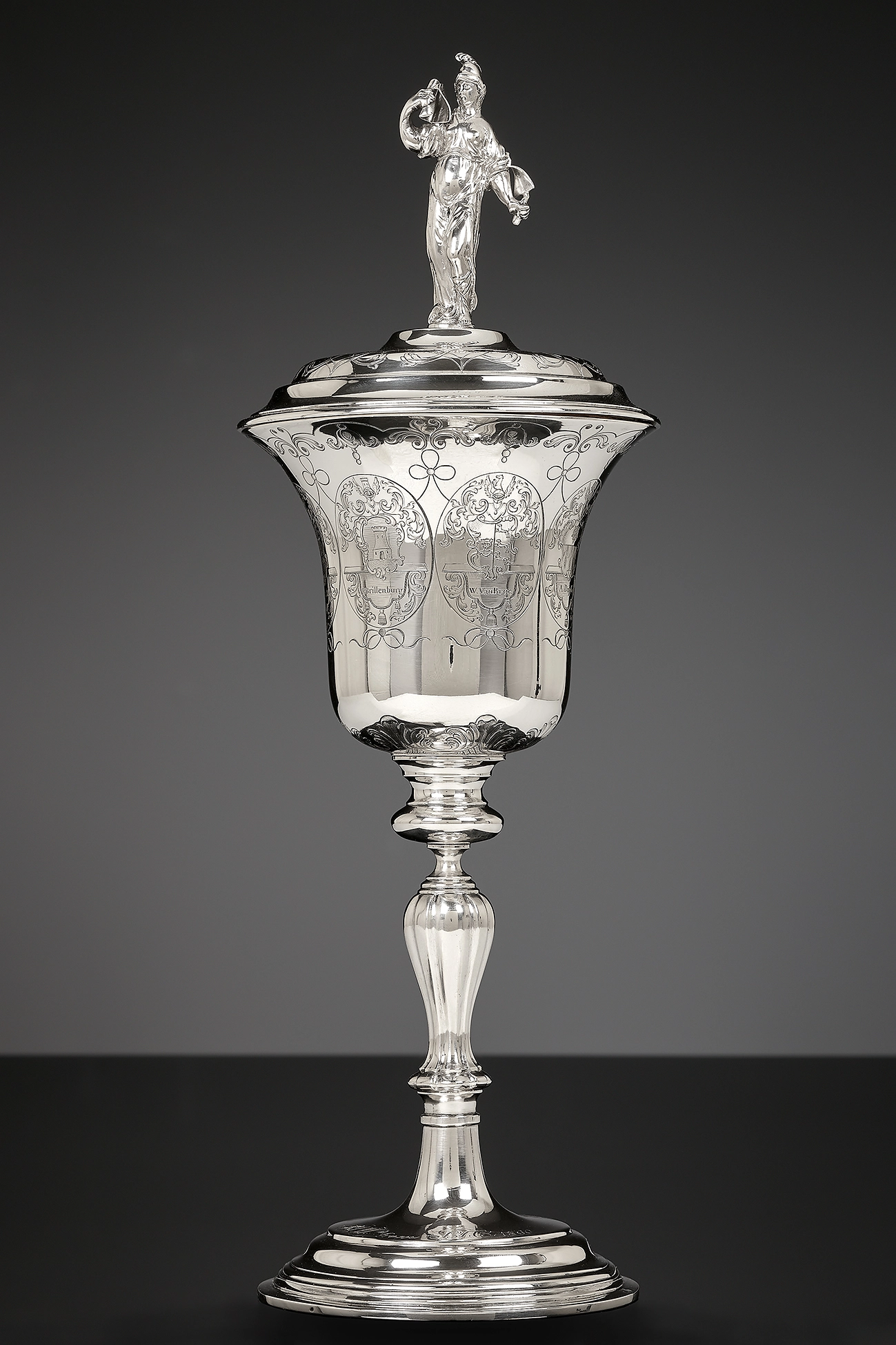
Inscription: coats of arms engraved within ovals on the cup, with the names I.V.D. Heim deken, Ari Lems, Jan Becol, I.V.D. Valk, P. Brillenburg, W. van Bree and A. Duyser.
Dated 1754 on the foot; later inscription RIW from SJC 1860.
A goblet with a slender, baluster-shaped foot and a bell-shaped cup with a lid topped by an allegorical figure. The cup bears seven engraved coats of arms and names, corresponding with the dean and headmen of the skippers’ guild of Schiedam in 1754. The later engraving on the foot indicates time spent as part of English collections in the nineteenth century.
Guild goblets in Schiedam
Three silver goblets from Schiedam guilds are known today: one from the Saint Nicholas’ Guild (the guild of tradesmen), one from the Saint Barbara’s Guild (the guild of masons), and this one, from the guild of skippers.
All three goblets were commissioned from Pieter van Gilse, who was born in Schiedam around 1715 to Jan van Gilse and Aagje Schouten. On 15 December 174, he married Johanna Bosschaart. They had two children: Jan Hendrick, who was baptised on 15 September 1748, and Agatha Engelina, baptised on 17 December 1751. Although both children were baptised by the Reformed Church, and he was married in the Reformed tradition, it was not until 29 November 1758 that Van Gilse was admitted as a member of the Reformed congregation by confession of faith. It is possible that he was originally a Remonstrant; this would explain why his own baptism is not recorded in Schiedam’s baptism registers, as Schiedam did not have a Remonstrant congregation.
From 1740 to 1780, Pieter van Gilse intermittently served as one of the headsmen of the Saint Nicholas’ or Tradesmen’s Guild, in which the town’s shopkeepers were united. The guild’s records provide no clear evidence of his occupation; in 1748, he gave his profession as silversmith, but after 1780, he changed this to gaarder van de gemenelandsmiddelen, which approximates to “gatherer of the common revenues” – in simpler terms, tax collector.
Although the name of Pieter van Gilse is noted in connection with multiple silver items from Schiedam, and the bill issued to the Guild for these items bears his name, it is very much the question whether he actually crafted them personally.
The bill
In 1754, the Skippers’ Guild of Schiedam elected to order a guild goblet from Pieter van Gilse:
“14 February, in the year of our Lord 1754. The deans and headmen of the Skippers’ Guild of the town of Schiedam are indebted to Pieter van Gilse 170 guilders and 14 stivers for a silver chalice for the aforesaid guild. Settled on the date above in S:Dam. P. van Gilse.”
(Guild archives, Municipal Archives of Schiedam, Old Administrative Archives, inv.nos. 3007 and 3015).
An additional bill dating from 1759 notes a modification made to a “Silver Goblet and a Blazon”, the latter presumably referring to a silver funerary shield belonging to the guild that has since been lost. Exactly how the goblet was modified is unknown; it may be that this is when the inscription was added.
The Saint Nicholas or Tradesmen’s Guild commissioned a similar goblet in 1756. The decision-making around this particular commission is interesting to examine more closely:
the joint heads, including Pieter van Gilse, decided to trade in fourteen silver spoons and fourteen silver forks in return for a silver chalice, gilt on the inside, with the likeness of Saint Nicholas on the lid and the coats of arms of the dean and headsmen engraved on the cup for the sum of 52 guilders and 14 stivers.
As they had provided silver, this guild only had to pay the maker’s fee, as opposed to the Skippers’ Guild, which also had to pay for the silver. This goblet bears the year letter Y for 1757 and bears the master’s mark ID, though the archived documents do not identify the maker. In 1795 – i.e. before the guilds were abolished – Pieter van Gilse bought the goblet back from the Tradesmen’s Guild for the sum of 65 guilders.
Another silver goblet was delivered to the Saint Barbara’s or Mason’s Guild, also in 1757. Again, the bill for this goblet survives to this day, informing us that Pieter van Gilse was paid a sum of 109 guilders and 16 stivers for this “goblet with an image thereon and the arms engraved thereon”.
The maker
All three goblets bear the master’s mark ID, the city mark of Rotterdam, the Holland coat of arms and a year letter. This master’s mark undoubtedly refers to the Rotterdam-based silversmith Jacobus Johannes Dreux. In older literature, this attribution has been questioned at times, in part because of the pieces in Schiedam that could be attributed to Pieter van Gilse. The baptismal font in Schiedam’s St John’s Church, for instance, bears the ID mark, while an engraving on the rim reads Pieter van Gilse me Fecit (“Pieter van Gilse made me”).
However, it is likely that Pieter van Gilse only served as a kashouder (see below), and did not craft any pieces personally. Supporting this hypothesis is an entry found in the guild book of the Rotterdam silversmiths from 1745, which notes that one Pieter Gilot in Schiedam was a kashouder. (Zilverschatten 1991, p. 236,237 and p. 224.) This is likely a scribal error, the person referred to in fact being Pieter van Gilse. A kashouder was a shopkeeper who sold silver works, usually crafted by others. This also explains why the bill was paid to Pieter van Gilse, rather than to the silversmith who crafted the piece.
Jacobus Johannes Dreux, the true maker of the works here discussed, became a poorter (a registered citizen) of Rotterdam in 1740. Originally from Arnhem, he married the Amsterdam-born Berdina van Engelen in 1743. Remarkably, it was not until 1745 that he became a member of the guild. His master’s mark ID features on all of the pieces that can be attributed to Pieter van Gilse based on the bills for their sale, which indicates that these two men had a close collaboration in the 1750s: the guild goblets and Schiedam baptismal font were all made in that decade.
Dreux was dean of the guild in 1772, 1774, 1776, 1780 and 1784. Following his death, he was succeeded as dean by Johannes Bitter in 1788.
The end of the guilds
The letter n stamped on Saint Barbara’s Guild’s goblets and the present goblet is well documented where this guild is concerned. In 1795, a decree was issued that all silver was to be surrendered. Those who wished to keep their silver were required to pay the value of the silver’s weight. The stamped n (in Rotterdam and surrounding regions; other cities used different letters or symbols) was proof that the piece had been discharged. For the Saint Barbara’s guild, the silver’s value was determined at 53 guilders and 14 stivers by Pieter Cornelis Dieprijcx, appointed assessor of unminted gold and silver by the municipality of Schiedam. Archived documentation contains a declaration by Dieprijcx that he applied the n stamp following receipt of payment.
In 1798, the Dutch guilds were abolished by order of the French. The municipality of Schiedam established a committee to take charge of the funds and property of the former guilds. The goblets of the Skippers and Mason’s Guilds were among the items that came into this committee’s possession, but the Tradesmen’s Guild’s goblet did not, as it had been sold back to Pieter van Gilse three years earlier.
The last of the guilds’ goods were sold in 1824 or 1825. This may be when the goblets disappeared from Schiedam, though we cannot rule out the possibility that they had already been moved elsewhere before that.
The lidded goblet in Van Gilse’s possession since 1795 was reunited with the other guilds’ goblets at some point after 1798. At that time, they must have been screwed apart – probably in order to clean them – following which the statuettes of the Saint Barbara’s or Mason’s Guild and the Skippers’ Guild were switched. This seems likely because the Mason’s Guild goblet now bears a Neptune figure, while the Skippers’ Guild goblet is adorned with a woman holding a trowel. This switch probably happened in Schiedam; after that, the goblets found their way to England, where they were separated. The two goblets now in the museum were gilded there, as was not uncommon, somewhere in the nineteenth century. The Skippers’ Guild goblet was furnished with an inscription.
In 1991, Stedelijk Museum Schiedam was gifted the two guild goblets by Bondsspaarbank Schiedam-Vlaardingen. The goblets had been offered to the museum for purchase by the Amsterdam-based Stodel company, but were beyond the museum’s financial capacity to acquire. The resultant risk that they would again be sold to a foreign buyer created a small public outcry in Schiedam, inspiring the Bondsspaarbank to purchase the two goblets for the reported sum of 135,000 guilders and to gift them to the museum.
The Skippers’ Guild goblet had a different journey; though it also found its way to England in the nineteenth century, it was sold there in the early 1960s and ended up in a collector’s hands via the art dealership Castendijk in Rotterdam. This goblet was exhibited three times: twice in Rotterdam and once in Schiedam, shortly after the museum’s acquisition of the other goblets.
Literature:
Meesters in zilver werk van Rotterdamse zilversmeden, tent.cat Rotterdam 1966, cat.no. 103, p. 33, avec des dimensions incorrectes, identifié à tort comme une coupe de la guilde des maçons
J.M.M. Jansen, ‘Schiedams Gildezilver’ in Scyedam 17e année no. 2 (mai 1991), pp. 48-52.
N.I. Schadee, Zilverschatten, drie eeuwen Rotterdams zilver, tent.cat. Rotterdam 1991, no. 138, p. 100, mentionné erronément comme coupe de la guilde des maçons
Red. S. Louis e.a., ‘De Gouden eeuw van Schiedam 1598-1795’, in Scyedam 23e année (février 1997) édition supplémentaire, p. 24,25