Dani Pascariu
a year ago
Great store, good prices (Netherlands)
Ships from The Netherlands
Price on request Price on request Price on request Price on request Price on request Price on request Price on request Price on request Price on request

Message the seller
Kollenburg Antiquairs BV
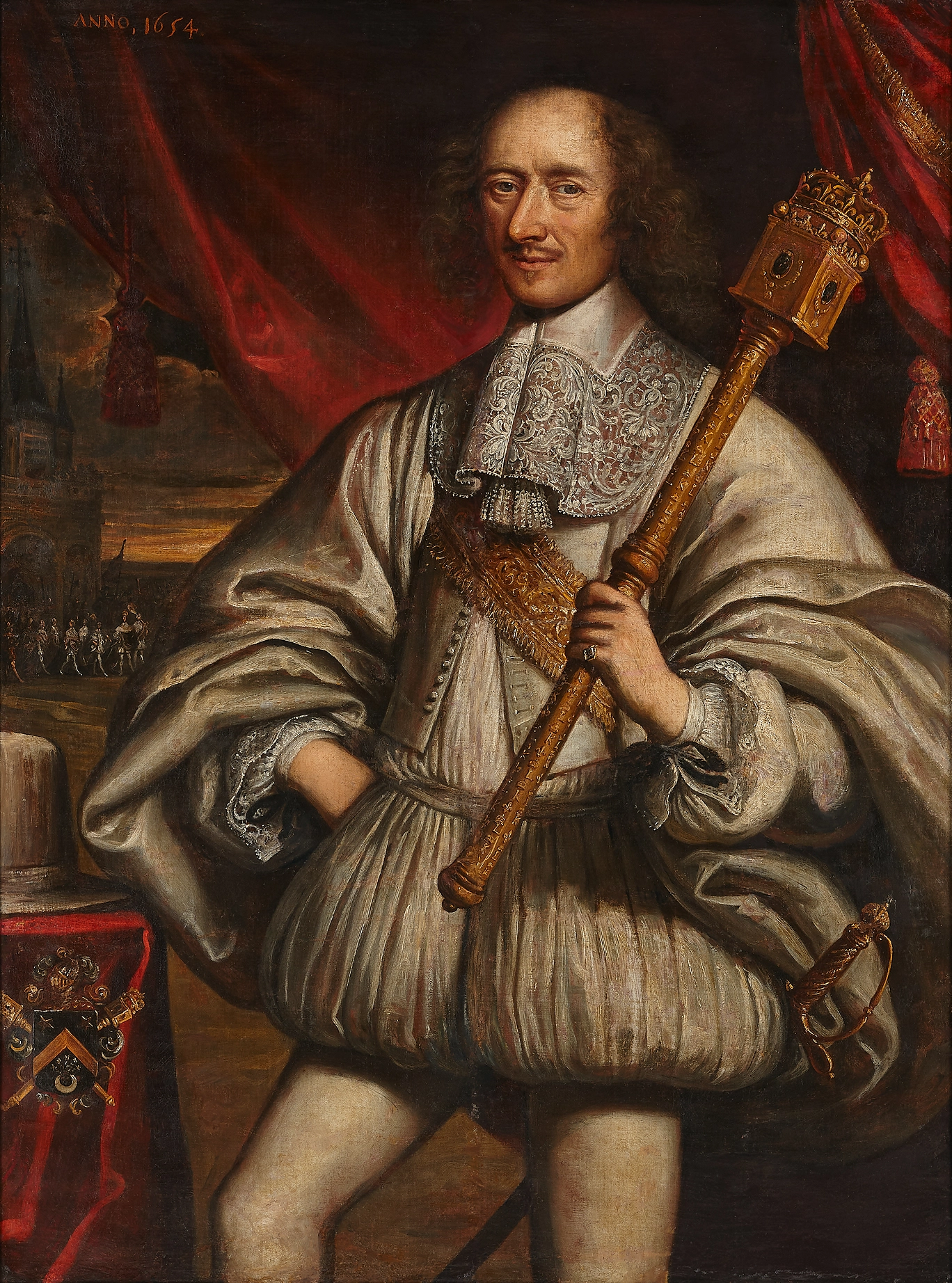
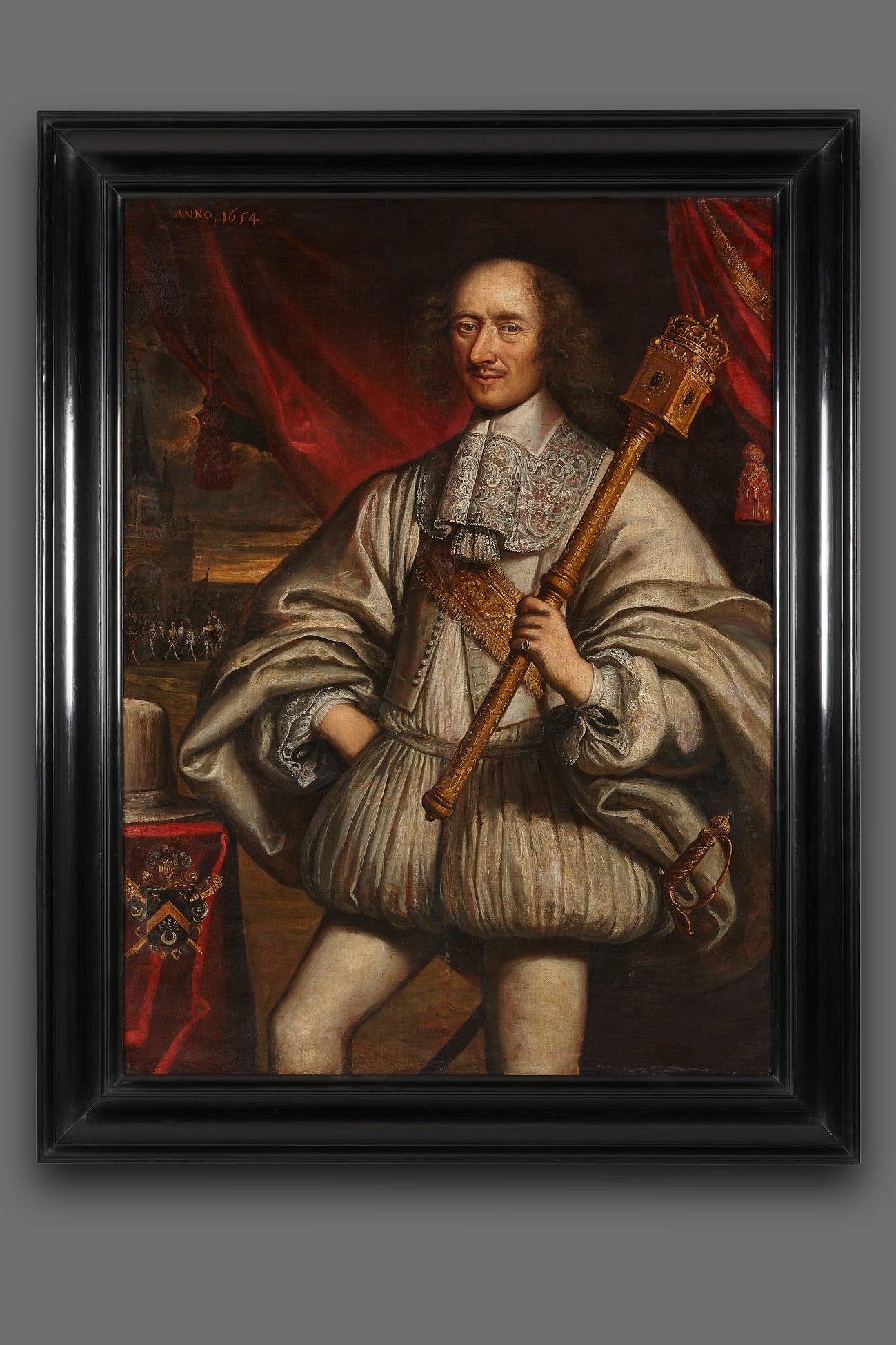
This painting of a man in court attire shows us one of the chamberlains of Louis XIV. The painting is dated 1654, the year of Louis XIV’s coronation in Reims. To the left of the portrayed figure, we see the newly crowned king departing Reims with his entourage. Marching alongside the king is the chamberlain himself, clearly recognisable by his distinctive staff.
The man in the portrait is Jacques Anthoine. He was born in 1596 at La Lobe ‘dit Mazarin, situé près de l'abbaye de Ligny, à une lieue de Rethel’ (i.e. La Lobe, known as Mazarin, situated near the abbey of Ligny, one league from Rethel) and died in Saint-Germain-en-Laye on 20 May 1677, where he was buried in the church. Anthoine was Louis XIII’s officier du roi and garçon ordinaire de la chambre du roi from 1642 to 1664, and left a manuscript describing the course of the king’s illness from 1643 up to and including his death on 14 May 1645. He married Catherine Guignard (1618-1652) on 2 December 1634, with whom he had two children.
Jacques Anthoine is first mentioned in the archives around 1643 and held his office until his death in 1677, making him the first in a long line of head garcons ordinaires that lasted until 1767, spanning five generations and a hundred and twenty-four years of service to the king. Though born a peasant, Jacques Anthoine was able to introduce himself to a young Louis XIII and to gain his favour. He continued to work at Louis XIII’s side until the king’s death. According to family tradition, from Louis XIII’s childhood onwards he enjoyed the goodwill of the king, who from time to time granted him various favours and conferred upon him two important offices at his court. By way of these two offices, he was always at the king’s service, both within and outside the kingdom, during the war and at the king’s wedding. When Louis XIV was crowned in 1654, he continued to serve as garçon ordinaire, and did so until his death in 1677.
Lacquer seal
On the reverse of the stretcher frame is a family coat of arms in red lacquer. These arms identify the lineage of Massias, an originally Spanish and subsequently French family: an azure (blue) background with a bend or (gold diagonal band) charged with a heart gules (bearing a red heart).
Nicolas Massias (born 2 April 1764, Villeneuve-sur-Lot; died 22 January 1848, Paris) was an artillery colonel, diplomat, philosopher and man of letters. He served as chargé d’affaires (minister plenipotentiary) of France at the grand ducal court of Baden from 1800 to 1807, and as French consul-general in Danzig from 1807 to 1815. On 25 January 1814, he was made Baron de l’Empire by Emperor Napoleon, a title confirmed with hereditary nobility by King Louis XVIII on 3 February 1819. He married Charlotte Böcklin von Böcklinsau. The Böcklin family arms are a silver goat with golden horns against a gules (red) background.
Their son Charles Jules Massias, also known as Karl von Massias, was the second Baron Massias (1801-1875). In 1831, he married Luise Johanne Pauline Karoline Freiin Böcklin von Böcklinsau, daughter of Friedrich Wilhelm Karl Leopold Freiherr Böcklin von Böcklinsau (1767-1829), a major-general in the service of Baden, and Caroline Freiin von Rathsamhausen. There were, in other words, two Massias-Böcklin von Böcklinsau couples: the father and the son. Stylistically, the seal on this painting more likely dates from the latter half of the nineteenth century, in which case it would designate Baron Charles Massias and his wife Louise Böcklin.