Dani Pascariu
a year ago
Great store, good prices (Netherlands)
Ships from The Netherlands
Price on request Price on request Price on request Price on request Price on request Price on request Price on request Price on request Price on request

Message the seller
Kollenburg Antiquairs BV
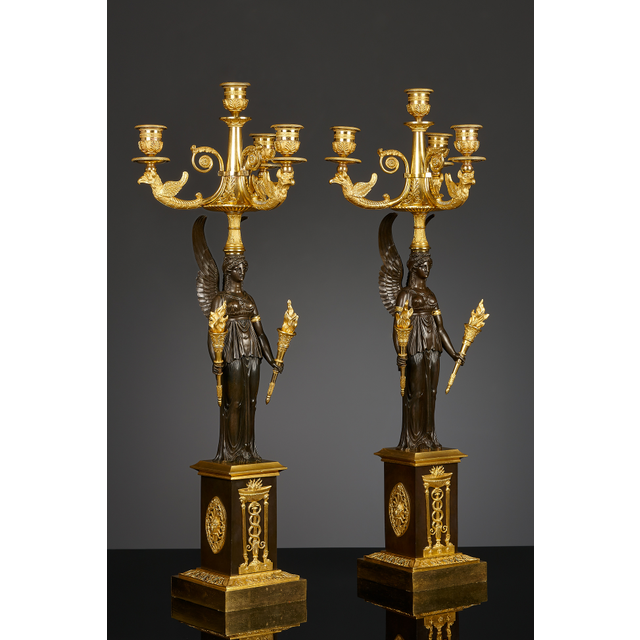
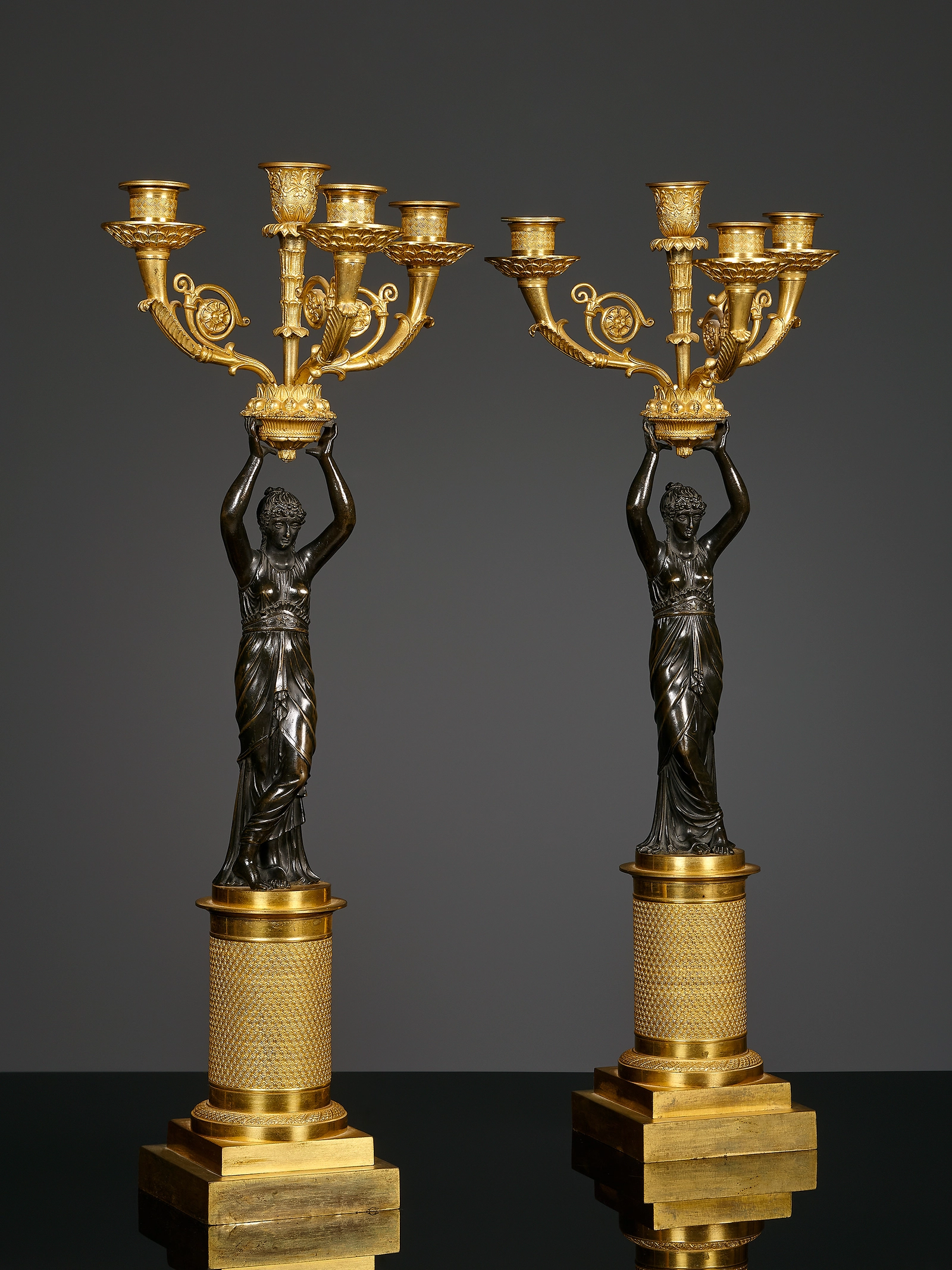
A pair of four-light French Empire candelabra with patinated bronze figures. The square, stepped plinth bears the cylindrical base upon which is set a patinated bronze figure in the shape of a standing woman with legs crossed and arms raised above her head, bearing the candelabra’s four branches in her hands. The four branches emerge from a basket filled with pomegranates, the central arm rising straight upwards and the remaining three arms extending to the front and sides.
Wingless female figures such as these are often described as Vestal Virgins, although here they carry not holy flame but a basket of pomegranates, which makes a reference to Persephone more likely.
Persephone was kidnapped while picking flowers in a meadow. Hades, god of the underworld and king of the dead, emerged from a crevice in a horse-drawn chariot and forcefully dragged her off with him. Her devastated mother Demeter spent a great length of time searching all over the Earth, then among the stars, asking Helios if he had seen her daughter. Helios answered that Persephone was with Hades in the underworld. Powerless to do anything and overwhelmed by grief, Demeter cast a cruel winter over the Earth, bringing starvation to its people. Ultimately, Zeus commanded his brother Hades to return Persephone to her mother. Hades agreed, but insisted that Persephone partake in one final meal before her departure, at which she ate six pomegranate seeds. Eating anything in the realm of the dead meant that you could never leave; for every seed she swallowed, Persephone was to spend a month in the underworld. So it came to be that every year, she spent spring and summer - the seasons in which life flourished - with her mother, after which she was forced to return to the lands below. The myth of Demeter, Hades and Persephone thus serves as the Greek mythological explanation for the creation of the seasons and their cycle. In this light, Persephone’s crossed legs could refer to the duality of her life: half on Earth, half in the underworld.
This candelabrum model is attributed to Claude-François Rabiat.
Rabiat
Claude-François Rabiat (1756-1815) was a prominent Parisian bronzier and doreur, whose skill significantly contributed to the decorative arts of the late eighteenth and early nineteenth centuries. Rabiat began his apprenticeship under Etienne Vignerelle in 1769 and reached the status of master in 1778, establishing himself as a master gilder of metals.
Rabiat worked from his workshop on Rue Beaubourg and was known for his exceptional gilt and patinated bronze pieces, including French mantel clock cases, candlesticks and other decorative objects. His creations were highly sought after by prominent bronziers and French mantel clock makers of the time, such as Pierre-Philippe Thomire, Claude Galle and Pierre-Victor Ledure. Rabiat’s part in the collaboration with these craftsmen often consisted in the supply of finely worked bronze components that formed an integral part of their celebrated pieces.
Despite working with celebrated figures in his time, Rabiat largely remained behind the scenes, and many of his contributions remain uncredited. Still, his signature does feature on a number of works, offering insight into his role in the creation of these masterpieces. After his death in 1815, Rabiat’s legacy was continued by his sons, who worked under the name Rabiat Frères (Brothers Rabiat) before each striking out on their own after 1819.
Today, objects by Rabiat’s hand are found in famous collections, including those of the Musée Marmottan Monet in Paris and Château de Valençay.