Dani Pascariu
a year ago
Great store, good prices (Netherlands)
Ships from The Netherlands
Price on request Price on request Price on request Price on request Price on request Price on request Price on request Price on request Price on request

Message the seller
Kollenburg Antiquairs BV
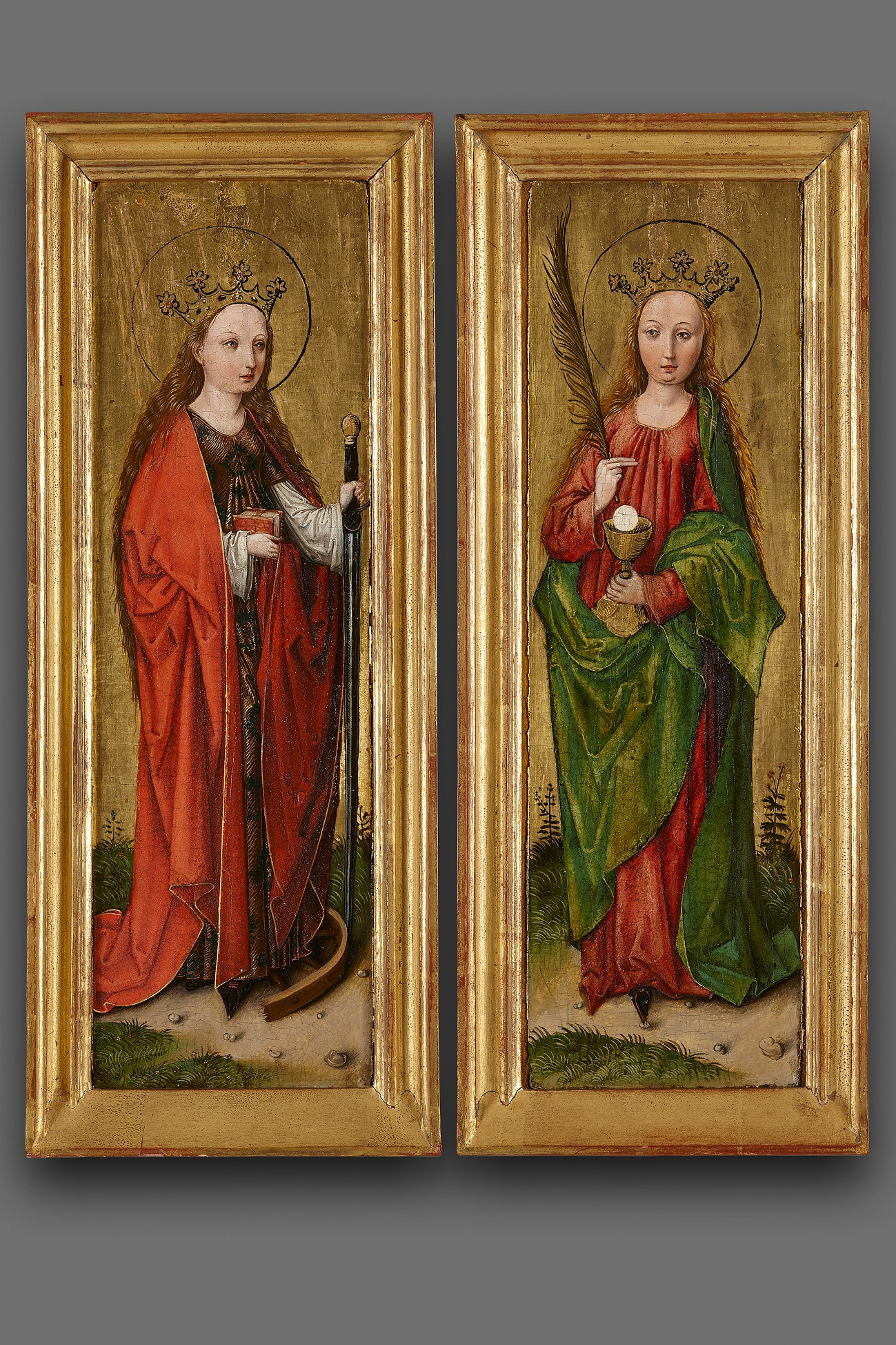
Two crowned female saints are depicted with their attributes against a golden background: Saint Catherine and Saint Barbara. The two small panels likely once formed part of a retable.
Saint Catherine
Catherine was one of the most popular saints in the Middle Ages. As one of the Fourteen Holy Helpers, she was invoked as a protector against the plague and a guardian of chastity. She was also occasionally considered a guardian of safe childbirth.
Catherine came from Alexandria, and was so devoted to Christ that she pledged her virginity to him. Shortly after this promise, Emperor Maxentius fell in love with her, but she rebuffed his advances in order to stay true to her vow. The emperor then sent forty pagan philosophers to convert Catherine, but instead of being swayed to pagan ways, Catherine converted them all to Christianity. Next, the emperor sought to have her tortured on a spiked breaking wheel, but the wheel was destroyed by lightning. Frustrated, the emperor tried to have Catherine burned, but the fire engulfed the executioners instead. Finally, Maxentius ordered Catherine’s decapitation. This attempt was successful; however, what flowed from the wound was not blood, but milk that saved the city from the plague.
Catherine’s body was carried to Mount Sinai by angels, where it remained in pristine condition when it was discovered by pilgrims in the year 800, nearly five hundred years later. St. Catherine’s Monastery was built next to the mountain.
This painting shows her bearing a sword and a book. The wheel on which she was tortured lies broken at her feet.
Saint Barbara
Barbara lived in Nicomedia, Bithynia, in the late third to early fourth centuries. She was the beautiful and intelligent daughter of Dioscorus, a rich pagan, who imprisoned her in a tower to protect her from the outside world and preserve her virginity. He forbade any contact with friends, only permitting her to see teachers and servants with the orders to educate her in the worship of pagan deities. Barbara spent years in the tower, hoisting food and laundry up and down using a basket on a rope. One day, a stranger handed her a book about Christianity. Upon reading it, she pretended to be ill in order to be attended by a doctor, who was in fact a priest who baptised her in secret.
Before leaving on a journey, Dioscorus ordered the construction of a bathhouse for Barbara, which was to have no more than two windows. However, during his absence, Barbara ordered the builders to install three windows, symbolising the Holy Trinity. When Dioscorus returned, he was incensed to find an additional window that he had not sanctioned. And when Barbara admitted that she had converted to Christianity and refused a marriage proposal he had arranged, Dioscorus truly flew into a rage. He brought her to the provincial prefect, who ordered that she be paraded naked through the city. However, a sudden mist veiled her from the public’s sight. The prefect next ordered that she be tortured and decapitated, yet Barbara refused to renounce her faith under torture, and her wounds were healed every morning. Her execution was ultimately carried out by her father. As he returned home, he was caught in a violent storm, in which he was mortally struck by lightning and consumed by flames that God sent down upon him.
It is because of this legend that Saint Barbara is invoked for protection against explosions and sudden death. She is venerated by Catholics whose professions carry a risk of unpredictable, violent death, serving as the patron saint of artillery operators, miners, firemen, sailors and prisoners. In Christian art, Barbara is always associated with the tower in which her father imprisoned her. Occasionally it appears as a building in the background; it is also not uncommon for the tower to feature as a miniature held in her hand, although placing the saint next to the tower had the advantage of freeing up her hands for other attributes. Commonly, one of these takes the form of an open copy of the Gospels. As to the other: she often holds a palm branch, symbolising her virginity, or a sword, symbolising her martyrdom, in her right hand.
Barbara is unique among all female saints in Christian art in that she is often portrayed with a chalice representing the Sacred Eucharist. This tradition emerged during the late Middle Ages, when veneration of Saint Barbara shifted its focus from her imprisonment and martyrdom to the miracles she was invoked for. Barbara’s posthumous miracles revolved around dying individuals who feared being unable to receive their last rites. By calling on Saint Barbara, they were able to receive their last rites and pass away in peace. As such, the tower – which formed part of her ante-mortem legend and was associated with her martyrdom – became less important, and artists gave it a different function, e.g. as a holder for the chalice and the host, or left it out altogether. This changing visual idiom occurred most markedly in Germany and the Netherlands during the late Middle Ages.
In the famous nineteenth-century collection of the Cologne-based Christoph Rhaban Ruhl, these two panels were attributed to Martin Schongauer. They were subsequently bought by Consul Weber from Hamburg, who opened his collection to the public as a museum and had his paintings extensively researched. The catalogues published about his collection recorded Catharine and Barbara as Oberdeutsche Schule mitte XV jahrhundert.
In 1939, Friedlander wrote the words Schongauer Kreis on a photo of these paintings that survives until today in his archives at the RKD. He would have already been familiar with them from the Weber collection, having written a foreword for it.
The Mathiessen Gallery in Berlin and Abels in Cologne later displayed the, possibly jointly possessed, paintings as“Circle of Schongauer”, likely at Friedländer’s suggestion.
“Circle of Schongauer” is a broad term, however. Schongauer was famous for his prints, which were already being used by other artists during his lifetime. As such, it is impossible to determine with certainty who painted these panels in the fifteenth century.
Literature:
Karl Woermann, Wissenschaftliches Verzeichnis der älteren Gemälde der Galerie Weber in Hamburg, 1892, p. 4, no 5
Karl Woermann, Wissenschaftl. Verzeichnis der älteren Gemälde der Galerie Weber in Hamburg, 2e auflage 1907, p. 12, no 10
Related content