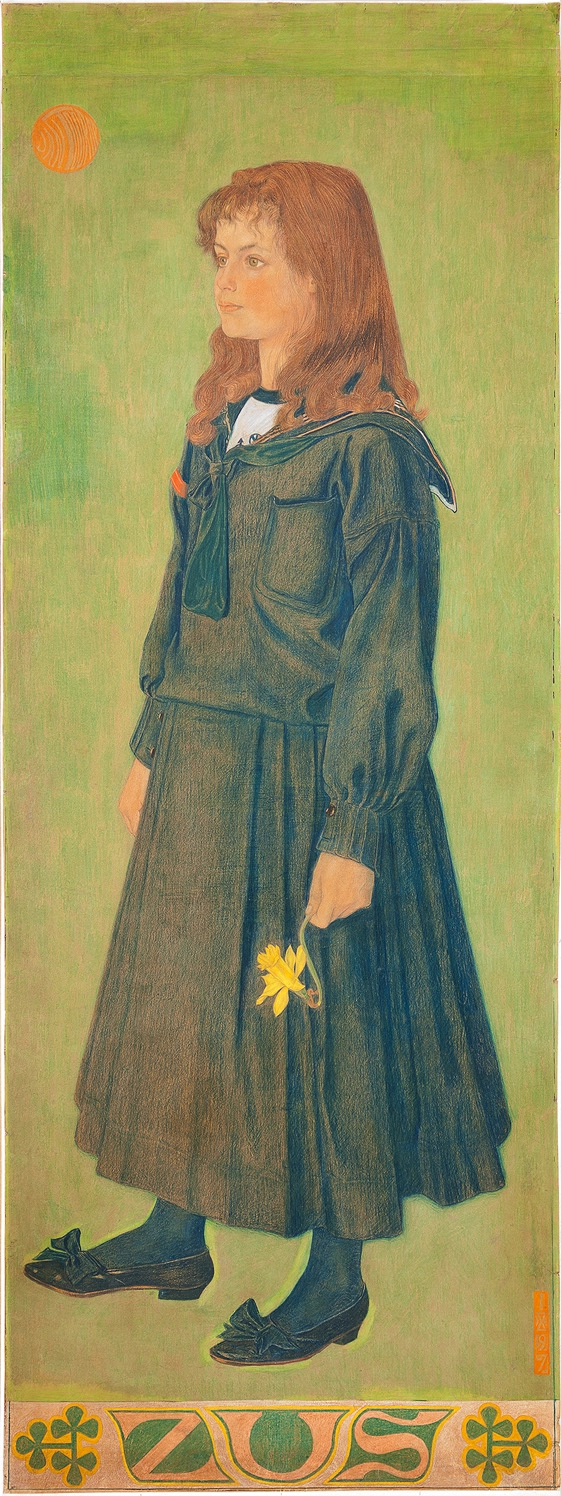
Sister Henny
Ships from The Netherlands
Price on request Price on request Price on request Price on request Price on request Price on request Price on request Price on request Price on request
Message the seller
Studio 2000 Kunsthandel
- Name
- Sister Henny
- Measurements
- Width: 71 cm, Depth: 178 cm
- Reference
- STUA100191
- Makers
- Jan Toorop (creator)
- Colors
- Green, Beige, Brown, Orange, Yellow, Black
- Materials
- Black and colored chalk on paper
- Periods
- 19th Century Antique 1897
- Subject
- Architecture Portrait
An outright exception in Toorops portraits is the full appearance of figures, like he did with the Henny-sisters. The triptych of which the drawing ‘Zus’ originally was part, was derived from Villa Henny at The Hague, the by architect H.P. Berlage designed house of Carel Henny, director of a large insurance company, and his wife Adriana van den Broek. Commissioned by the Henny’s, Toorop made lifesize portraits of their daughters for the musicroom of the villa, according to Berlage’s ideas concerning architecture as a ‘Gesamtkunstwerk’ (a total work of art, or ideal synthesis of the arts). The wellknown Dutch artcritic Philip Zilcken wrote in 1898, when the drawings were not yet present at Villa Henny, that they would not be hanged as seperate paintings, but arranged in the wall to make a part of the whole, both in line and in color.
The simple, oak frame, designed by Berlage in which the drawings were framed, has been lost after the children left the parental home and each took their own portrait. The frame was still there at the ‘Wiener Secession’ in 1902, were Toorop exhibited his artwork (see ill.).
At the entrance of this exhibition, a poster of Toorop was visible next to a warning text: ‘Wer solcher Meisterkunst nicht mag, für den ist mein Haus nicht gemacht’ (free translation: ‘For whom this great art does not approve, my house has not been made’). For the people in Vienna this was a redundant statement, because Toorop was adored by them. At the Secession, Toorop did fullfil a special position with a whole exhibition room dedicated to his work. On a prominent place at that room was the triptych with the portraits of the Henny-sisters: Anna (1882-1927), Adrienne (1889-1983) en Helena (‘Zus’, 1885-1921).
Toorop portrayed the sisters, dressed in fancy dresses and Shoes, in separate, undefined spaces. Because of the twisted posture of Anna and Zus, he created a coherent whole. Toorop showed three different poses of the face: ‘en profil’, ‘en face’ and ‘en trois quarts’. The violin, ball and daffodil in the hands of the girls each symbolize specific aspects of their different characters at that time: the musicality of the eldest daughter Anna, the playfulness of the youngest, Adrienne, and the interest for nature of Zus.
The portrait of the Henny-sisters was one of the 23 artworks that Toorop showed at the Secession of 1902, but it certainly did not remain unnoticed. Fellow artist Koloman Moser thaught that the piece should have had his own wall. He said about Toorop’s work: ‘Sie wissen wohl nicht welcher Toorop-cultus in Wien besteht.’ (Free translation: ‘You do not know at all about the Toorop-cult in Vienna.’)