Dani Pascariu
a year ago
Great store, good prices (Netherlands)
Ships from The Netherlands
Price on request Price on request Price on request Price on request Price on request Price on request Price on request Price on request Price on request

Message the seller
Kollenburg Antiquairs BV
marked: crowned lion / maker's mark / city mark of Amsterdam / date letter D
Weight: 2773 grams
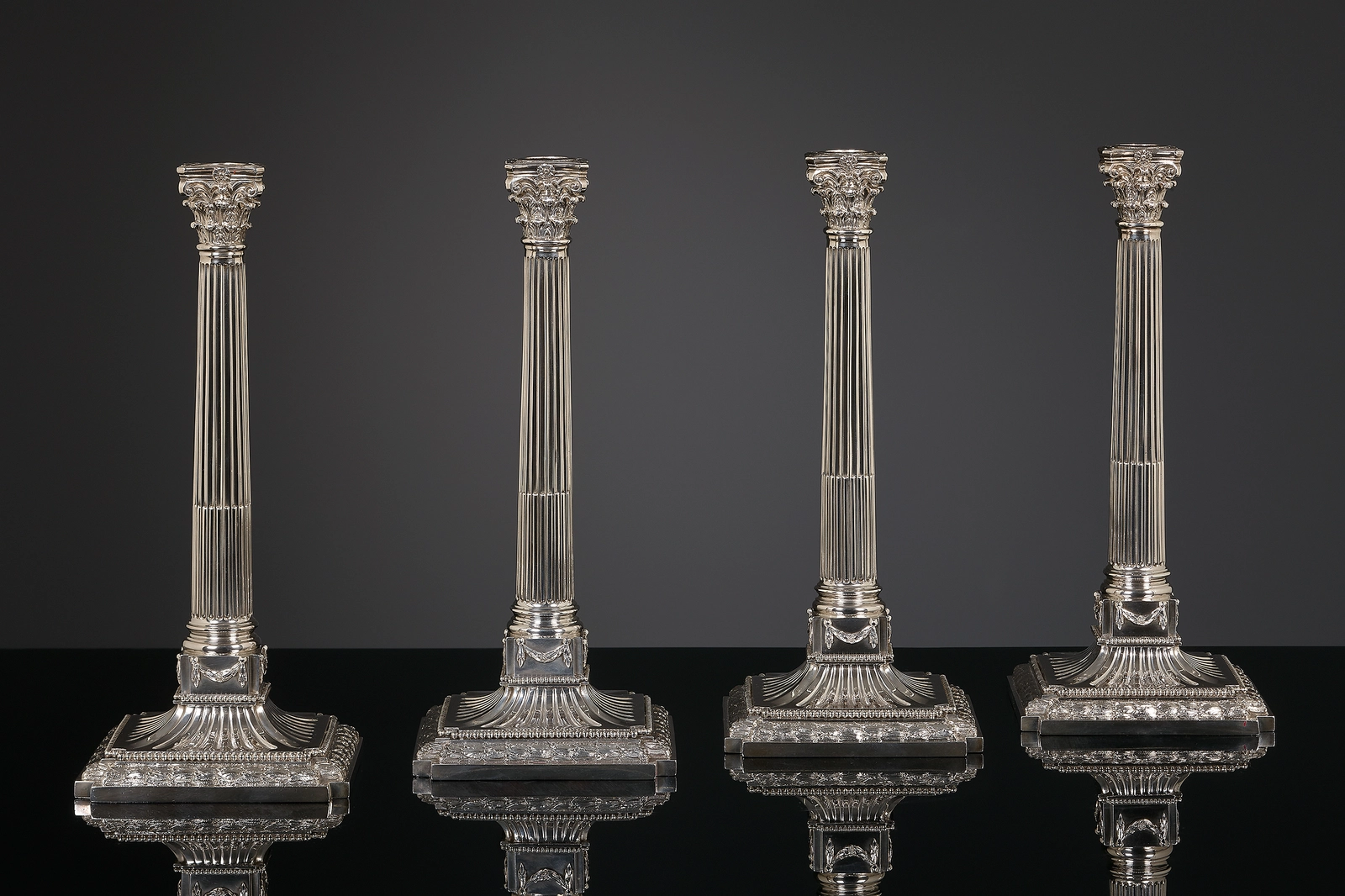
The candlesticks are modelled as Corinthian columns, standing upon square bases with notched corners. Each candlestick’s base is decorated with a broad, formal leaf border, above which runs a beaded border. Fluting and applied festoons complete the whole. The candlesticks are fully marked on the inside of the base’s rim, with an assay scrape beneath, and marked with the Amsterdam re-assay mark of 1795 on the base rim.
Dirk Evert Grave (1735-1795) was born the son of Jan Evert Grave, a clog maker, and Anna Maria Vorkenbrink. He became a poorter (burgher) of Amsterdam in 1763, and is recorded in the guild register as a master silversmith from 1765 onwards, also serving as kashouder (treasurer) from 1789 on. His master’s mark, an anvil, likely alludes to his family name, which means “heavy”. He died on Kalverstraat in Amsterdam in 1795. His widow was still recorded as treasurer in 1798 and 1807.
Much like his name, Dirk Grave’s works may be described as weighty: he was a largeworker who crafted silver objects in a pure Louis XVI style, including a large number of candlesticks. Most of these were heavy objects constructed from cast components, such as the rims and curving sections of the bases and the candleholders. In almost all cases, the quality of the casting is very high. Grave also produced candlesticks of this type with round notches at the corners, an early example of which can be found in a pair of candlesticks from 1771/72, now in the collection of the Amsterdam Museum. He often introduced small variations, for example in the height or the ornamentation, by adding a scrolling branch around the stem or lowering the base’s curving section. To current knowledge, it appears that Frederik I Manicus was the only other craftsman to use the same design. Although Johannes Schiotling certainly produced similar candlesticks, his generally differ more markedly from those produced by Grave, with narrower fluting. Other candlesticks by Grave with this square base are known, produced for instance in 1777 and 1778.
Notes
Amsterdam Museum, inv. no. KA 21815.1/2, depicted in L.E. Van den Bergh-Hoogterp (ed)., Stavelij jaarboek 2005; and in Hubert Vreeken, Achttiende-eeuws zilver van het regentengeslacht Van Hoorn in het Amsterdams Historisch Museum, Nijmegen, 2005, p. 76, img. 4.
Th. M. Duyvené de Wit-Klinkhamer, M.H. Gans, Geschiedenis van het Nederlandse Zilver, Amsterdam, 1958, img. 114.
One example is a set of six candlesticks in the collection of P. Hoogendijk, Naarden, 2007.
Literature:
E. Voet, Merken van de Amsterdamse Goud- en Zilversmeden, Den Haag, 1912, nr. 508.
K.A. Citroen, Amsterdam Silversmiths and their Marks, Amsterdam, 1975, nr. 1220 (beschreven als het merk van Jan Smit, maar nu toegeschreven aan Dirk Evert Grave).
J. R. de Lorm, Amsterdams Goud en Zilver, Zwolle, 1999, p. 506.