Dani Pascariu
a year ago
Great store, good prices (Netherlands)
Ships from The Netherlands
Price on request Price on request Price on request Price on request Price on request Price on request Price on request Price on request Price on request

Message the seller
Kollenburg Antiquairs BV
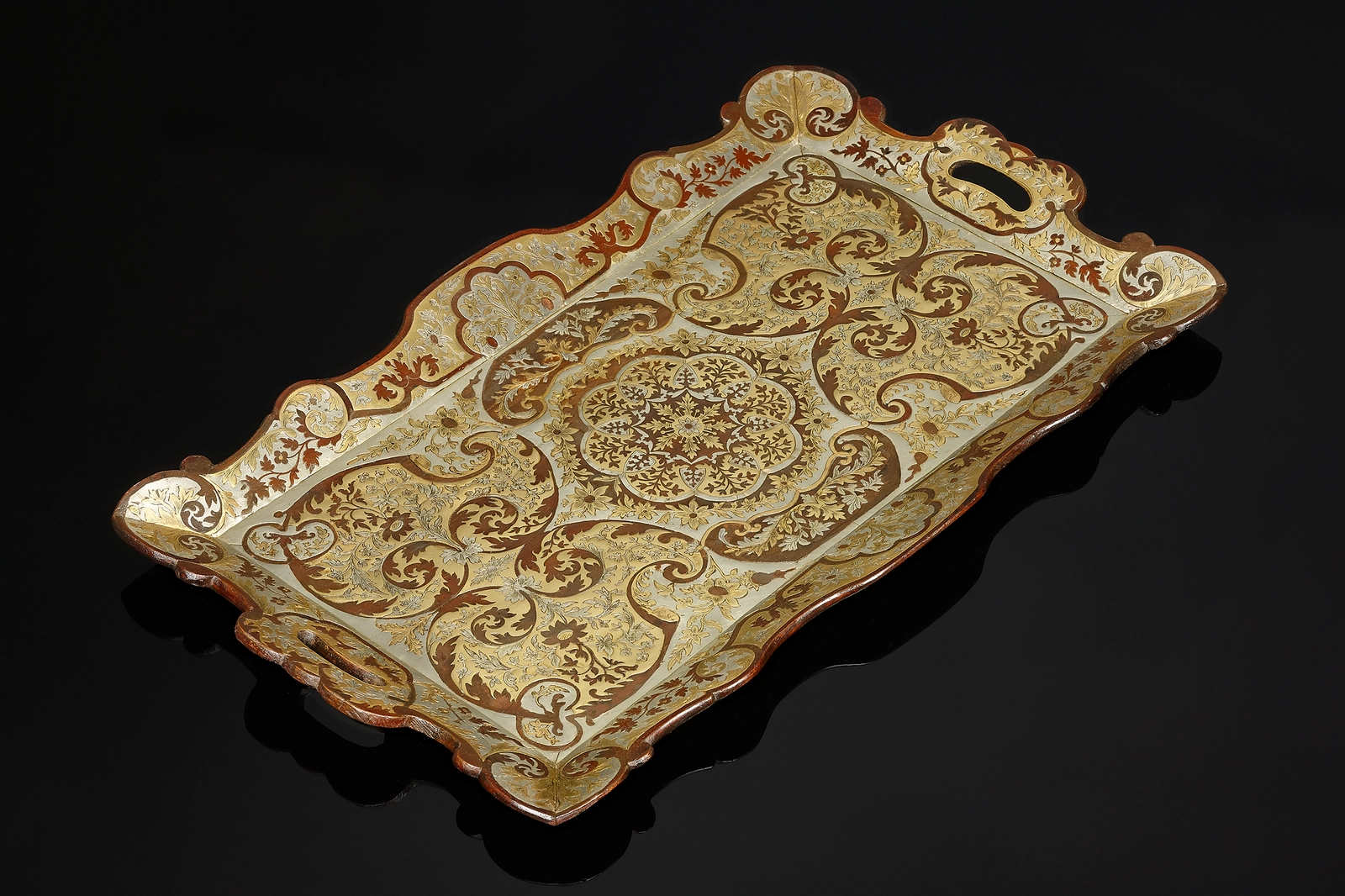
A rectangular mahogany serving tray with an undulating raised edge, the whole inlaid with brass and tin using the so-called Boulle technique. Based on the employed technique and the design, this tray can be attributed to the Bavarian furniture-maker Franz Xaver Fortner.
Franz Xaver Fortner (1798-1877) was one of the most prominent furniture-makers in Munich in the first half of the nineteenth century. He opened his workshop in 1826, and by 1842 he employed thirty apprentices. In addition to pieces made for export to France, Great Britain and Saint Petersburg, Fortner displayed his works at international exhibitions and was commissioned by Ludwig I of Bavaria to craft pieces for Hohenschwangau Castle and Leuchtenberg Palace.
In addition to creating pieces in the Empire style, he was also one of the earliest exponents of early historicism, as is evident for instance in the neo-Gothic furniture pieces he crafted in 1835 for King Ludwig (1786-1868), for use in Hohenschwangau Castle. Fortner’s technique was a revival of the old Boulle technique, whereby inlays were created using metal, ivory and tortoiseshell. He likely created his first piece using this technique in 1840 - an armchair for the grand duke of Baden. Another example of early Boullework by Fortner can be found in a neo-Gothic table in Stolzenfels Castle near Koblenz.