Dani Pascariu
a year ago
Great store, good prices (Netherlands)
Ships from The Netherlands
Price on request Price on request Price on request Price on request Price on request Price on request Price on request Price on request Price on request

Message the seller
Kollenburg Antiquairs BV
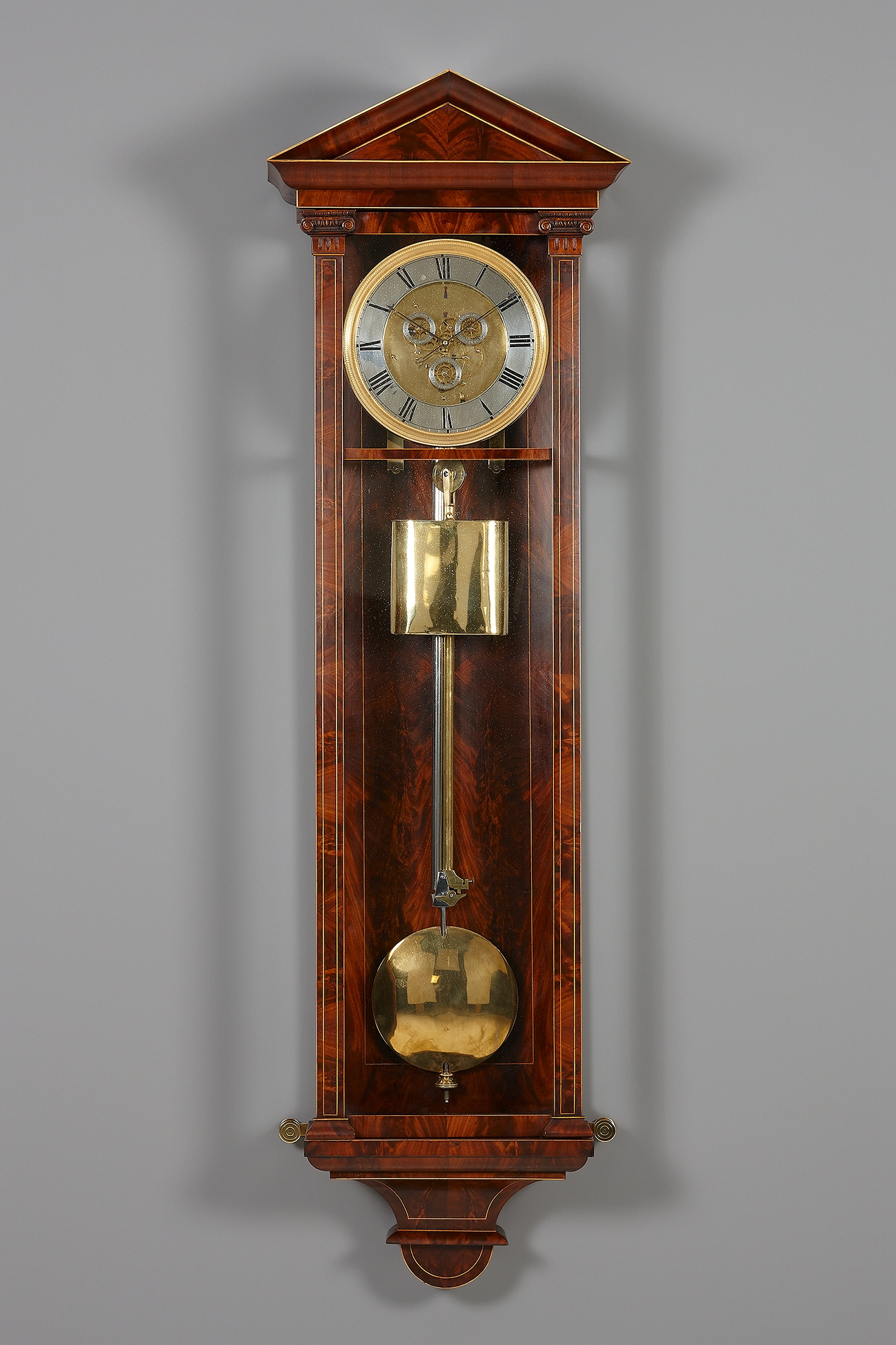
This regulator clock has a twelve-month going train with a deadbeat (Graham) escapement. The movement is contained within a closed round drum and bears the signature Joseph Binder Wien on the reverse. The solid silver dial is mounted on the drum, and features Roman numerals indicating the hours. In the centre of the dial are three smaller solid silver numeral rings indicating the days of the week, the days of the month, and the date, respectively. All hands are blued steel. Within the case, the movement is affixed to a solid brass bracket. The unusual temperature-compensated pendulum of brass and steel can be adjusted at the suspension points as well as at the base near the lens by means of a regulating screw. The movement is driven by a single weight.
The clock sits within a so-called Dachluhr case veneered with mahogany and a fruitwood intarsia and is crowned by a tympanum-shaped hood. The clock is accessible via the front by way of a glazed door; the sides of the case are also glazed.
The Viennese regulator clock emerged in the early nineteenth century; the earliest specimen dates from approximately 1790. At that time, Austria was allied with France, and Napoleon had proclaimed himself Emperor of France. Empire-style furniture and architecture were in fashion, the latter characterised by straight structures and pointed roofs.
Viennese regulators in the Laterndluhr and Dachluhr styles are generally considered to date from the Empire period, although Dachluhr clocks continued to be made well into the Biedermeier period. Clocks produced before 1850 tended to have sleeker shapes than later clocks; their lines were more refined, their cases narrower and they were, overall, more straight-lined than the often highly ornamented styles that followed. The Laterndluhr form was simplified during the Biedermeier period, resulting in clocks that more closely resembled a square stacked upon a rectangle (the shape associated with Dachluhr clocks). Later yet, from approximately the middle to the end of the Biedermeier period, these Viennese clocks acquired some degree of ornamentation at the top, while losing the division between the upper square and bottom rectangle. More Viennese regulators were crafted in Germany than in Austria, but because German factories did not begin producing clocks of this type until after 1850, nearly all such clocks made before that year came from Vienna or other hubs of the clockmaking industry, such as Prague, Linz or Budapest.
Joseph Binder was born in 1785 and apprenticed under Casper Brӓndl, who at the time worked at Biberbastei NR 1176 in Vienna, from 1802 to 1812. Binder became a master clockmaker in 1826. One of his clocks, a handsome astronomical pendulum clock with multiple complications, was displayed at the Allgemeine oder Central-Gewerbsproducten-Ausstellung (Product and Trade Exhibition) in Vienna in 1835. This clock was later incorporated into Vienna’s famous Sobek collection. Casper Brändl, Binder’s master, retired as a clockmaker somewhere between 1815 and 1818. There are many similarities between these two makers’ clocks; Binder even produced a number of clocks for Brändl during his apprenticeship, at least one of which bears a scratched signature by Binder, although the clock itself was signed by Brändl. Binder died in Vienna in 1833.
Literature:
Erika Hellich, Alt-Wiener Uhren; Die Sammlung Sobek im Geymüller-Schlössl 1750-1900, Wenen, 1978