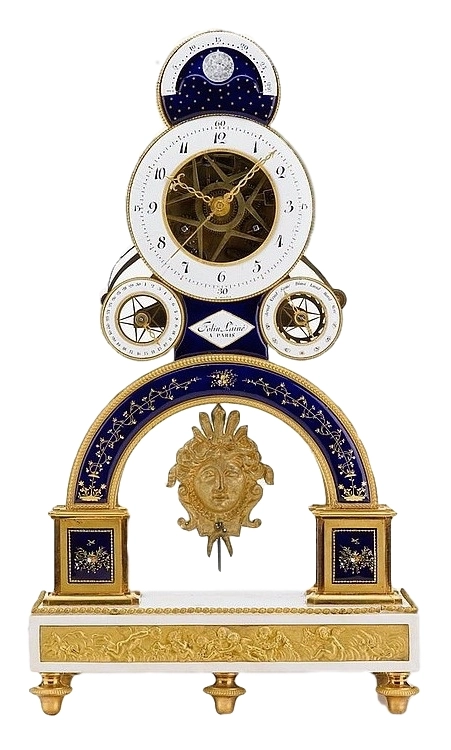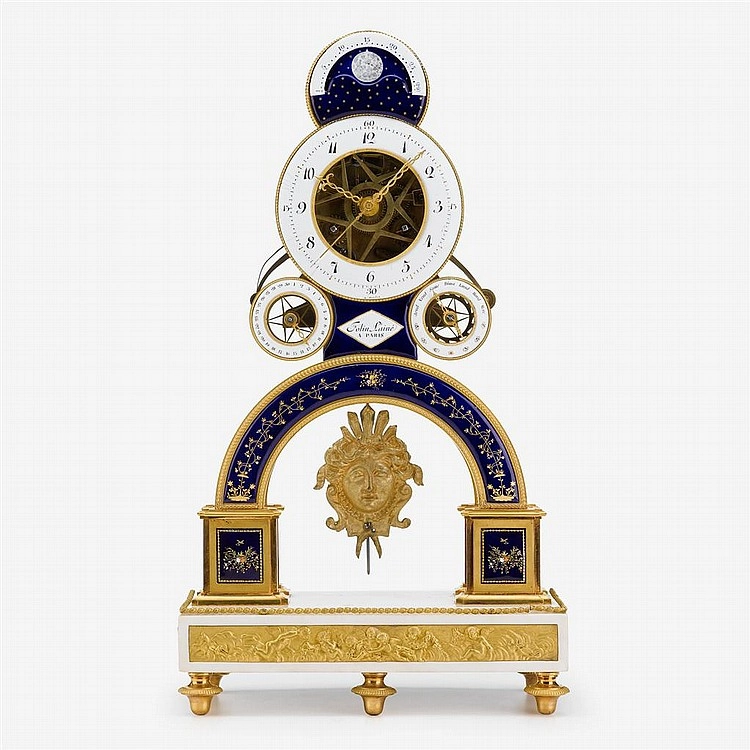
Fine Directoire ormolu and enamel pendule squelette the movement by Nicolas-Alexandre Folin, enamel by Georges-Adrien Merlet, circa 1795
White enamel chapter ring with Arabic hours signed G. Merlet, open to the center to reveal an openwork gilt bronze star before the movements, surmounted by a subsidiary enameled moon phase dial, above subsidiary white enamel dials showing the day of the week and sign on the right and the date on the left, the dials flanking a white enamel lozenge signed "Folin L'ainé A PARIS", all above a gilt and enameled arch raised on a marble plinth with ormolu frieze and five toupie feet.
Nicolas-Alexandre Folin (French, c. 1750-1815) began his career as a trinitaire, one of the ouvrier libre who received eight years of training in a craft at the Hôpital de la Trinité. After completing his studies he was made Master of the Guild in 1789 and quickly achieved renown for his movements and case designs. Of particular note were the skeleton clocks Folin designed and had enameled by Georges-Adrien Merlet (French, b. 1854-1802). Merlet would come to be one of the most highly regarded enamelers of the period, equal only to Joseph Coteau and H. Fr. Dubuisson.
A similar clock by Folin and enameled by Merlet is included in the collection of the J. Paul Getty Museum, Los Angeles. This example is illustrated in Gillian Wilson, D.H. Cohen, et. al, European Clocks in the J. Paul Getty Museum, The J. Paul Getty Museum, Los Angeles, 1996, pp. 140-147.
Origin and period
France
Name
S20 Directoire ormolu and enamel pendule squelette, the movement by Nicolas-Alexandre Folin, enamel by Georges-Adrien Merlet
We use our own cookies as well as third-party cookies on our websites to enhance your experience, analyze our traffic, and for security and marketing. Select "Accept All" to allow them to be used. Read our
Cookie Policy.